
Project details
- Client
- Client name
- Year
- 2026
- Author
- Author name
GenoRoots: a digital genealogical archive
GenoRoots is the tool used to organize and present on the website the data about people, their relationships, and the photos in which they appear. It was designed for Kamilari, in such a way that it can also be used on other websites. Today it is used on two: on the Kamilari website, for the village families, and on GeoTour, for historical family trees of Crete.
How the data is organized
The basic unit is the person. For each person, the name, gender, birth and death (date and place), notes and, where available, a portrait are recorded. Where known, the place of burial, the historical period in which the person lived, and the sources from which the data originates are also recorded. Dates are entered as we know them: if a source only mentions “1908” or “December 1936”, it is recorded as such, without adding precision that does not exist. Approximate dates are noted as such (“c. 1850”).
Relationships are organized into families, i.e., couples with their children. Siblings are not entered separately; they are derived from the common parents. For each family, it is noted how certain the relationship is: whether it is documented by sources, whether it is probable, or whether it relies solely on family tradition. On the person’s page, the last two cases appear with the corresponding indication next to the relationship.
In addition, persons are placed into groups, such as the village clans. A person can belong to more than one group, for example, the family they were born into and the one they married into.
A website can host more than one tree, independent of each other, called collections. Each collection has its own page, and its people and groups do not mix with those of other collections.
Each person has a permanent number, which never changes. The connection to the photo archive is based on this number. Finally, a person can be linked to an article on the same website that refers to them, so that the reader can pass from one page to another.
Presentation on the website
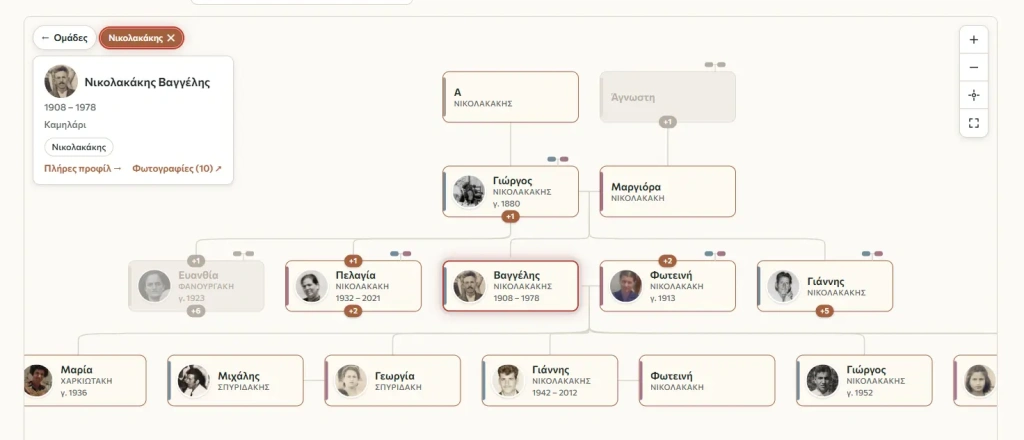
Navigation starts from the groups. Each group appears as a circle, with a size proportional to the number of its members. Where member portraits exist, they appear faintly inside the circle and alternate slowly, without covering the name. By selecting a group, its members appear; by selecting two, the people who belong to both appear. This way, the ties between families, which are usually due to marriages, are visible. On the first visit, a short hint above the member list explains that selecting a person opens their tree.
From each person, the visitor moves to the tree. The tree is not displayed in its entirety; it has the selected person at the center, with their parents, spouse, and children around them. The card of the person in the center stands out from the rest with a bold outline and a slightly larger size. By selecting a relative, the tree moves so that the center shifts to them. Thus, the transition from generation to generation happens gradually and the reader does not lose their orientation. Where a portrait exists, it appears on the person’s card.
Each person also has their own page, with their details, close relatives, the section of the tree around them, sources, and, where available, the link to the relevant article.
Connection to the photo archive
The Association’s photos are in the photo archive, separate from the website. During cataloging, for each person identified in a photo, their name is recorded along with their permanent number, in the format “Name [number]”.
GenoRoots reads these indications from the archive and matches the number to the correct person. Each person’s page shows how many photos they appear in and leads to them. The matching is based on the number and not the name, so that it is not affected by differences in spelling or by namesakes, which are common in villages. The archive remains the source for the photos and the tree the source for the people; GenoRoots simply connects them, without altering the archive.
This connection is currently used only in Kamilari. It is optional, and GeoTour operates without it.
Transition from the previous application
The data from Kamilari’s previous application were transferred as is: about sixty people and twenty families, as many as had been recorded until then. The person numbers were kept because they had already been used in cataloging the photos. The old page addresses automatically redirect to the new ones, so that links already shared are not lost.
Data entry and maintenance
Such an archive is only valuable if it can be updated by members of the Association without technical knowledge. Data entry is done via a form in Greek, and relationships (parents, marriages, children) are defined by selecting people from lists. Each person’s number appears on the same screen, ready for use in cataloging the photos.
When there is a lot of data or it already exists in a genealogy program, it is imported in bulk from a GEDCOM file. The import can be repeated: people are recognized by their number and updated, without creating duplicate records.
Languages
The GenoRoots interface, namely the buttons, titles, and labels, is translatable and currently exists in Greek and English. Dates appear in the language of the page (e.g., “15 January 2026” in English). For names, writing in Latin characters is also provided.
In Kamilari, the website operates in Greek, and the English version is being prepared, aimed mainly at descendants of Kamilari abroad. On GeoTour, the trees appear in the eight languages of the website. The translation of texts (biographical notes, places, periods) is done automatically by GeoTour’s translation system. The Greek names of the people are entered manually and the machine translation does not change them.
Use on other websites
From the beginning, the goal was for GenoRoots not to depend on Kamilari. It is a standalone plugin for WordPress, the platform on which the websites of many associations and organizations are based, and it can be installed on any website of this type. It adopts the colors of each website, translates into other languages, and imports data in GEDCOM format, the common standard for genealogy programs. Thus, a community that has already recorded its families in such a program does not need to rewrite them. The connection to a photo archive is optional.
What differs from website to website is defined by the website itself and not within GenoRoots: page addresses, colors, order of first and last name, whether a name search is displayed. GeoTour is the first case where this was applied in practice.
The adaptation for GeoTour added certain features to GenoRoots itself: collections, burial place, historical period, sources, indication of relationship certainty, connection to articles, and portraits inside the group circles. These features are available to any website using the current version.
Beyond other villages and cultural associations, the same scheme can serve diaspora communities, local historical archives, or educational projects, where the relationship between people and families is part of the story they tell.
GenoRoots on GeoTour
GeoTour is a website for the places of Crete: villages, monuments, routes, with a map and pages for historical figures. There, GenoRoots is used for family trees of families that have a place in the island’s history. Today there are two collections:
Venizelos: the Venizelos family of Mournies and Halepa and the families they were connected to by marriage (Ploumidakis, Mitsotakis, and others), from the late 18th century to the present day. It includes 42 people, 15 families, and 7 groups.
Xylouris: the Xylouris family from Anogeia, from Antonis “Psarakis”, whom tradition remembers as a fighter in the 19th-century revolutions, to the brothers Nikos (Psaronikos), Antonis (Psarantonis), and Giannis (Psarogiannis) and subsequent generations. It includes 19 people, 6 families, and 3 groups.
The data for the two trees was gathered from published sources (bibliography, encyclopedias, press publications), which are listed on each person’s page. People and relationships that were not found in a citable source were not entered, even if they are mentioned elsewhere. Where sources disagree, such as the year of birth of Psarantonis (1937 or 1942), the disagreement is noted in the text. For living people who do not have a public role, only their name and position in the tree are recorded.
GeoTour adds the connection to places to the trees, without changing GenoRoots itself. Each person can be connected to GeoTour place pages, with a note about what happened there and when (“Born”, “Born and buried”, “Lived here”). These people appear:
on the GeoTour map, as smaller and fainter markers than those of historical figures, so they stand out on the page of each place, along with the relevant people: below the historical figures, with an indication that they are a family member and the name of the tree they belong to
When a person already has their own historical figure page on GeoTour, like Eleftherios Venizelos or Nikos Xylouris, they appear only once, as a historical figure, and their page in the tree leads to it.
The connection to places is only made where there is a page for the place on GeoTour. Places like the Nikos Xylouris museum in Anogeia or the Venizelos family tombs in Akrotiri do not yet have their own page and will be connected when created.
Examples in operation
Kamilari:
The families of Kamilari: https://kamilari.org.gr/mele/
GeoTour:
- All trees: https://www.geotour.gr/family-trees/
- The Venizelos family: https://www.geotour.gr/family-trees/venizelos/
- Eleftherios Venizelos in the tree: https://www.geotour.gr/family-member/eleftherios-venizelos/
- The Xylouris family: https://www.geotour.gr/family-trees/xylouris/
- Giannis Xylouris (Psarogiannis): https://www.geotour.gr/family-member/giannis-psarogiannis-xylouris/
- Mournies, with the Venizelos family members connected to the village: https://www.geotour.gr/listing/mournies-chania/
- Anogeia, with the Xylouris family members: https://www.geotour.gr/listing/anogeia-anogia/
Limitations and open issues
A tool does not solve the problems of sources. The accuracy of the tree depends on the documentation of each item, and oral testimonies, no matter how valuable, need cross-referencing. The relationship certainty indicator helps the reader distinguish the documented from the probable, but does not replace research. Grouping into clans is also a choice of the Association, or the author of each tree, and not an objective fact.
On GeoTour, the sources are mainly secondary: encyclopedias, biographies, and press publications. For older generations, information is scarce and dates are often missing. The machine translation of texts into other languages may contain errors, which are corrected when spotted.
Special attention is required for the data of living people. A public genealogical archive must balance recording memory with respecting privacy. This is an issue that will continue to concern the Association, as well as any website using the tool, as the archives grow.